Unless you are just getting back from vacation, you're probably aware of the big news that Google made a $125 million investment in Lending Club on Thursday. Almost all the major news sites covered this event. The investment (a 7% stake in the company) values Lending Club at a staggering $1.55 billion, and makes the company a likely future hallmark of American finance.
To help newcomers to the lending scene, today's post will review the entire peer to peer lending scene in the US. We will begin with the major platforms, cover the major news sites and blogs, and finish with the available tools and forums.
Let's get started.
{ 9 comments }
Part 1 – Introduction: Risk
Part 2 – Avoiding Defaults
Part 3 – Low-Grade Loans
Part 4 – Multiple Filters
Part 5 – From Tools to Platforms
While avoiding bad risk (defaulting loans) might be the main reason we use filters, we also want to consider taking on some good risk – namely in the form of adding some lower grade loans. This is because adding some risk can be really rewarding! Let’s look at an example and do a filtering exercise to discover the potential in riskier low grade loans.
{ 2 comments }
A lack of strategy is one of the most common problems investors face on Lending Club. Once someone has opened an account and transferred funds over from their bank account, it can be confusing to figure out what to do next. This problem is easy to see in the variety of success that different people experience on Lending Club. Some lenders thrive while others lose money. So what is the difference between the two?
Today we will examine seven important strategies the average investor can use to achieve solid returns on Lending Club.
{ 3 comments }
Part 1 – Introduction: Risk
Part 2 – Avoiding Defaults
Part 3 – Low-Grade Loans
Part 4 – Multiple Filters
Part 5 – From Tools to Platforms
Unlike a mortgage, peer to peer loans are unsecured. When a borrower fails to pay their loan back (called a default), the lender loses their entire investment. Almost every lender will experience a default eventually, but there are two important ways to soften the blow. First (and most important), we can be diversified in at least 200 loans. Second, we can choose to invest in the highest quality loans available, the loans that have the lowest chance of defaulting.
So which loans are least likely to default?
In part 2 of this filtering series, we will do our best to answer this important question. The reality is, just a little filtering goes a long way in our attempts to avoid defaulting borrowers.
{ 0 comments }
Continued from part 1 & part 2
When I began lending, I enjoyed it for different reasons than I do today. This is why, in this series, I have been referring to it as a "her", because in many ways my relationship with peer to peer lending has matured and changed since it first began. Like a crush, this avenue of online lending began as a thrill. But soon, like a romance, that thrill matured into something like deep respect and admiration, something worthy of commitment.
Here's how it happened.
{ 2 comments }
Part 1 – Introduction: Risk
Part 2 – Avoiding Defaults
Part 3 – Low-Grade Loans
Part 4 – Multiple Filters
Part 5 – From Tools to Platforms
Lending Club and Prosper both give you the ability to filter their available loan pool. The quality of your filter will strongly affect whether your notes become healthy or unhealthy over time. Lenders with good filters are less likely to experience defaults and more likely to have thriving consistent returns. A good filter is key.
So what is the recipe for a good filter? To answer that question, let’s take a minute to look at a basic element of investing in general, particularly the idea of risk.{ 0 comments }
There are a few forces on the face of this big blue Earth which cannot be stopped. For instance, gravity. We fight it with construction, rockets, and plastic surgery, but these efforts only slow it down. Eventually, gravity always wins.
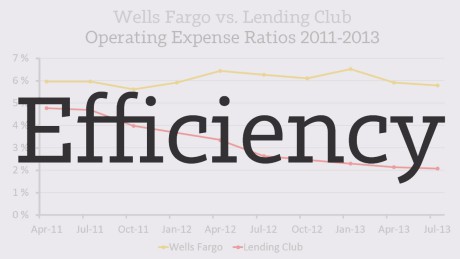
I would argue that there is another unstoppable force in this world, and this is the triumph of efficiency, the victory of things that use less energy over things that use more. Eventually, an efficient thing wins over an inefficient thing: foraging for food was surpassed by planting crops, the chariot made ancient by the tank. We can resist it or delay it, but efficiency always wins.
In today's post, I hope to convince you to attend the LendIt conference in Manhattan on June 20. The subject of interest will be online lending, an avenue that allows people to efficiently lend money to each other without the inefficiency of the banking system. While the future is unknown, this change in lending looks to be the largest shift to happen to the American economy since the advent of the internet, and LendIt is going to be a day where some of the largest voices in online lending talk about what this shift means.
{ 3 comments }
Each quarter I post the current state of my peer to peer lending accounts. I am a lender who enjoys maximizing my return through highly-targeted low-grade loans. I opened my first account in September 2011, and have opened two more since then. Last quarter I was uncomfortable in showing off my account values, but this quarter I have gotten over my discomfort because I want people to see how great the returns of peer to peer lending are, as well as how committed I am to it.
As you can see in the following table, I continue to celebrate thriving positive returns on both Lending Club and Prosper.
{ 8 comments }

Learn the Basics


Recent Comments