To encourage more people to start investing, each quarter I post the current state of my personal peer to peer lending accounts.
Because of my age and life-situation, I am an investor who feels comfortable taking on more risk than most investors. While this means my returns are probably higher than average, the risk also means my portfolio is more susceptible to macro economic factors like a rise in national unemployment. Most investors might prefer staying in the safer graded loans.
Returns for Q4 of 2014 (Trailing 12 Months)
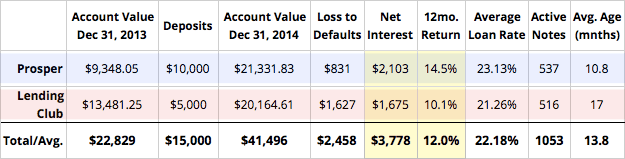
As seen below, I continue to celebrate great returns at Lending Club and Prosper:
Some notes on these returns:
- Account values, defaults, and interest are pulled from each platform’s monthly statements (See your Lending Club Statements // Prosper Statements).
- The important figure of Net Interest (highlighted in yellow) is calculated by taking the sum interest earned for the past twelve months and subtracting that period’s total value of defaulted loans.
- Annual Return, also highlighted in yellow, is done via XIRR (see: XIRR calculator), the best way to independently calculate your peer to peer returns. Most investors will probably not need to go to such lengths, and can trust the onsite return at Lending Club or Prosper.
- With an average age of 11 and 17 months, the notes in these accounts are not yet seasoned. Read: The P2P Return Curve
- All returns are pre-tax.
Lending Club IRA: Earning 10.1% Interest
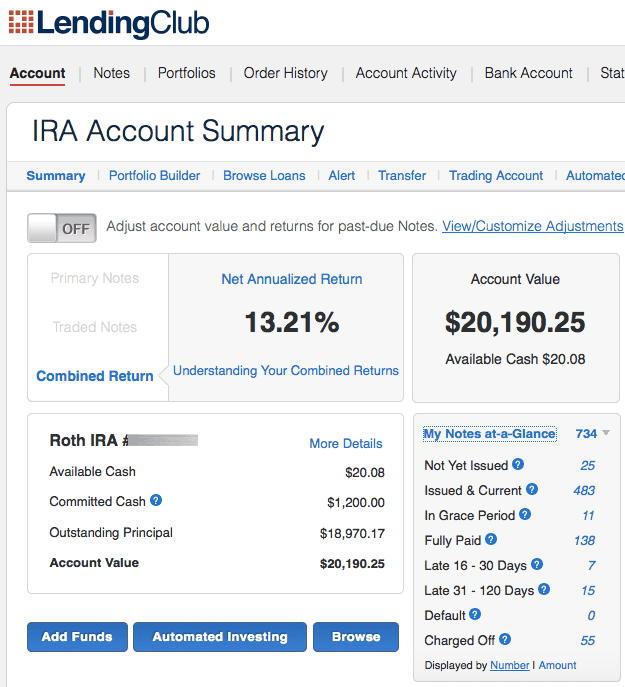
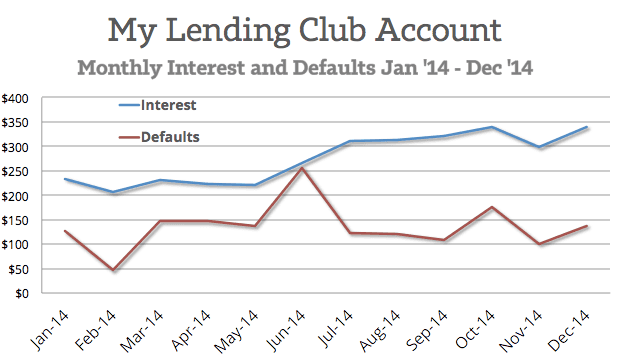
My Lending Club IRA remains an incredibly rewarding way to save for retirement. As this account continues to have a sizable number of unseasoned notes, its returns continue to drop slightly quarter by quarter, this one being 0.3% lower than the last. Interestingly, the account’s monthly interest and defaults moved in tandem over the past three months:
Here’s a further breakdown:
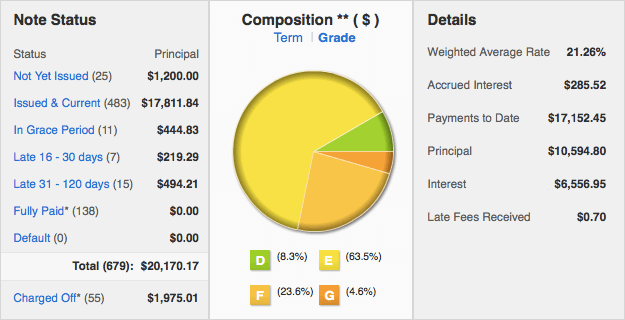
Probably the most obvious insight from the above graphic is how heavily tilted my account is into E-grade loans. While this lack of loan grade diversification might increase the overall volatility of this account, I still feel comfortable taking on this risk considering the return it offers.
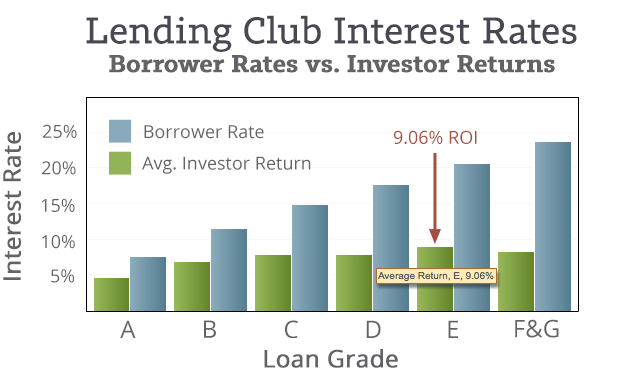
E-grade loans give the highest ROI at Lending Club. Leaning into them while utilizing a few extra filters seems to me to be a great strategy moving forward.
Prosper Taxable: Earning 14.5% Interest
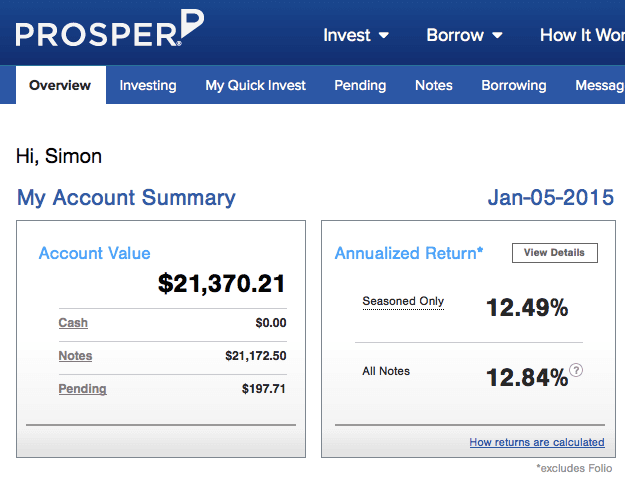
The $10,000 lump sum I deposited in mid Q3 came roaring out of the gate this quarter. In the month of December alone I experienced almost zero defaulting principal while earning over $400 interest.
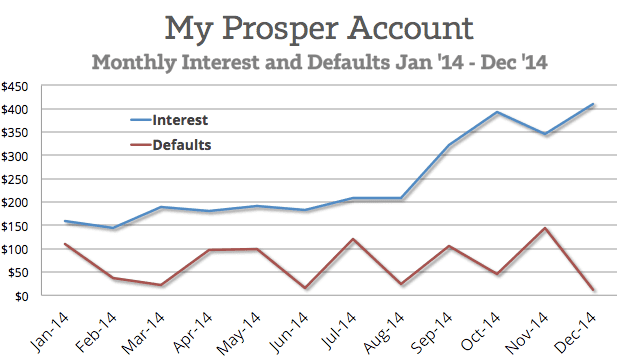
Here’s a further breakdown:
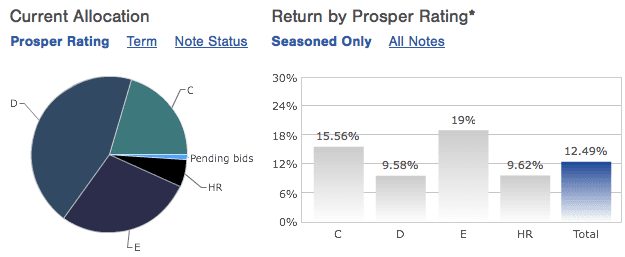
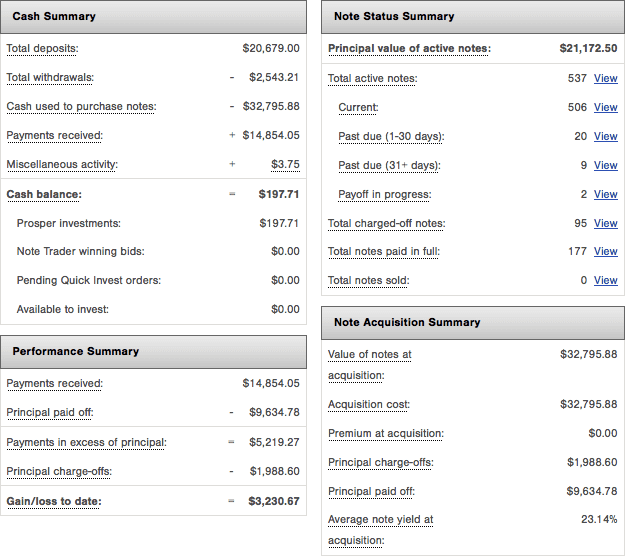
This current 14% is unsustainable, but welcome while it lasts. You can bet the following quarters will see a rise in my default rate as many of these new loans fail to get paid back. Loans almost always default sooner rather than later. Read more: The Three Seasons of the Return Curve
Overall, I continue to be really happy with my Prosper account. Similar to Lending Club, E-grades remain my most rewarding grade. They seem to be the sweet spot for my goal to hit the highest yield possible, but your experience may differ from mine. Also know that you’ll probably need to invest via API if you want to lean into them as much as I’ve done since so few are casually available. And, as always, you should be aware of the risks of low-grade loans.
Curious what filters I use for this Prosper account? Here they are.
My Future Returns: Probably Around 9%
Readers may notice how my Lending Club return dropped slightly from last quarter while my Prosper account increased dramatically (see 2014Q3). The main reason for this difference is the Lending Club account being better seasoned (average note age is 17 months). In contrast, half of the loans on my Prosper account are new investments, meaning many will default in the coming months, bringing my Prosper ROI closer to my Lending Club ROI.
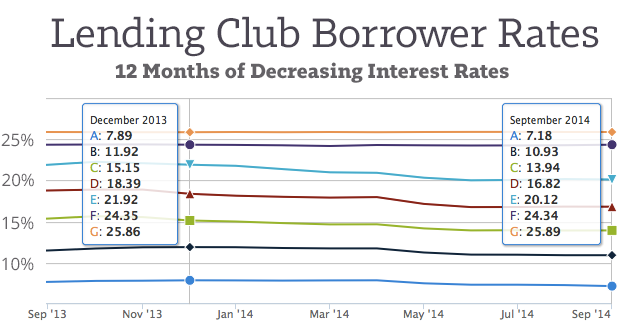
I do plan to continue to shoot for 10% returns on both accounts, but actually feel 9% is a more realistic return for the coming year. As seen in the chart above (hat tip to NSR), lower rates are where the industry is headed. Since December 2013, Lending Club has substantially decreased the rates they offer borrowers, with D-E grade rates falling by almost 2%. This is a big change for investors, and something to watch closely in the coming year.
In my opinion, the cause of this adjustment is peer to peer lending’s investor demand. Many many people want to invest in these loans, so it only makes sense for platforms like Lending Club to keep lowering interest rates to attract more borrowers. Even so, a 5-9% return is a remarkable investment year over year.
Something isn’t making sense to me with your Lending Club numbers… if your Loss to Defaults is $1627 and your Net Interest is $1675, doesn’t that mean you only made $48?
Hi Jeff. Good question. The *net* interest is the interest earned after defaults are subtracted. Total interest was around $3,200. See point #2 below the figures.
Ah… I missed that point, focused on the numbers. That makes more sense!
Hey Simon,
outstanding article, thanks for sharing all the details.
Peter from lendacademy made a similar observation. His returns decreased while the defaults increased. It appears that the P2P lenders are adjusting the loan categorization in favor of the borrowers. At this point I think that borrowers are in higher demand than investors. To attract more borrowers, loans are provided at lower rates while the risk for the investors is increased. So an individual that was maybe categorized with a D2 on Lending Club two years ago, would now be categorized C5 under the same conditions (just made that up as an example).
The higher default rate is even more of a surprise, considering that overall economic situation in the US improved significantly over the last 12 months. Unemployment rate decreased while the FED is ending quantitative easing and will probably increase the interest rates by mid 2015.
Just my two cents!
Cheers
Fabian
Simon, thank you as always for sharing your returns. The downward trend of interest rates is certainly been noticeable and significant, especially for those of us investing the bottom half the spectrum. I’d imagine this will have some strong impacts in the coming years as these notes “overtake” a portfolio’s weighted average with time.
Interesting also to note the weakness in your Prosper D-grade loans in comparison to C and E around it. I, too, have a similar dip, but not as prominent as yours.
Regardless, as a means for providing diversification and future income, P2P continues to be a strong part of my future plans.
Thanks Adam. Great to hear your experience has been as rewarding as mine.
Thank you for posting your experience, was curious who do you use for your IRA custodian and how is your experience with them in terms of user interface and customer service?
I meant the IRA custodian for your lendingclub IRA account.
Hi Danny. I used the custodian SDIRAServices, which was the default one for Lending Club at the time. That said, I have not been too impressed and am actually considering moving somewhere else.
It is really time for me to get back into the P2P lending space. Believe it or not, but I actually had jumped on this train back in 2010. But then I saw much more opportunity in real estate and stocks and ended up selling a lot of my loans on the prosper trading platform. That move looks pretty good now.
However, the stock market is feeling a bit toppy. And it is time for a little more asset diversification.
Glad I stumbled onto your site.
Cheers!
Great to hear :) Thanks for stopping by.
Hi Simon,
I saw from one of your 2013 updates that you were leveraging a p2p loan that you had received from Prosper, I believe. How has that worked out? I am considering this strategy myself. Barring a catastrophic amount of defaults, it seems almost flawless: Get a loan at 7%, reinvest it at 10%, add 3% to returns. Or is there something I’m missing?
Hi Nate. That was kind of an idea I played with for a few months until common sense got the best of me. While it was interesting to try, I wouldn’t suggest it for most people. 10% returns are getting rarer these days, and most won’t qualify for a 7% loan. Also, borrowing to invest has a history of people getting burned.
I’d considered leverage too. But as a retail investor, there are some headwinds.
First,the larger investors (FIs) have some pretty sophisticated models and that allows them to identify and invest in invest in the best high yield notes. LC and Prosper used to have some assignment algorithms that helped counteract this advantage but as more and more FIs that join the party there remain only so many slices of each note.
Second, retail borrowing rates are no where near the cost of funds for an FI. I know few retail investors that can borrow at 25-50bps.
Third, there are a number of borrowing variables to consider:
– Is the rate variable or fixed?
– Does the term of the borrowing match the investment timeline?
– What will it cost me to originate the note?
– How quickly can I deploy new capital?
Some Examples:
– Credit Cards offer 0% fixed for 12-18 months then 10%+ variable and you have a 2-4% BT/check fee.
– LC or Prosper 7-10% fixed for 36 or 60 months plus an origination fee.
– Taking a loan on automobile (that you own outright) 4% fixed for 24-60 months plus fees.
Then you have Simon’s point, margin compression as investor demand drives down rates for borrowers. This appears to be largest in the lower credit tiers where the best yields are and leaves less room for error or note volatility.
In summary, I agree with Simon. There are risks and it’s not for everyone.
Hi Simon,
First time reader of your site – thanks for the obvious effort that goes into this!
I came across here through your post describing P2P lending as an ethical solution to high interest lending providers (credit cards, payday loans, etc). I appreciate your search for investments that are both rewarding and ethically sound.
In your this post, I see that the average interest rate for your investments in Prosper and Lending Club are 23% and 21%, respectively. Forgive my ignorance here, but are these the interest rates charged to the borrowers? These still seem remarkably high (not that great of an alternative to credit cards).
Just wondering your opinion on this. These certainly seem like rewarding investments, but I’m wondering if providing loans with interest rates north of 20% is still considered an ethical investment?
Thanks for your thoughts.
Thanks StillLearning. This is a question that people regularly ask, so don’t think you’re wrong for doing so. The short answer is that, yes, these borrowers are getting charged 21-23% in the loans I’m giving them. However, this isn’t necessarily a bad thing. The large majority of these borrowers are coming from credit card debt with a similar or higher interest rate like 30%. And for the vast majority of them, moving from 5 variable rates and 5 different bills coming in the mail to a single loan with a fixed rate is a huge relief, even if they are paying a similarly high interest rate. So I still feel really good about helping them out.
Of course, there will be less wise borrowers who take 23% interest rated loans to fund a wedding or something equally dumb, but these are the minority.